MANAGEMENT CYBERNETICS · STRATEGY · ARTIFICIAL INTELLIGENCE
I study how organisations stay viable in a complex world, and how AI can help people decide better.
Professor of Strategic Management and Business Administration at Weiden Business School, OTH Amberg-Weiden, and Programme Director of the MBA General Management at ISM International School of Management, Dortmund. Founder and CEO of CEREBRA Laboratories AG, working on early dementia detection, and Scientific Director of the CEREBRA Institute for AI in Neurodegeneration Research.
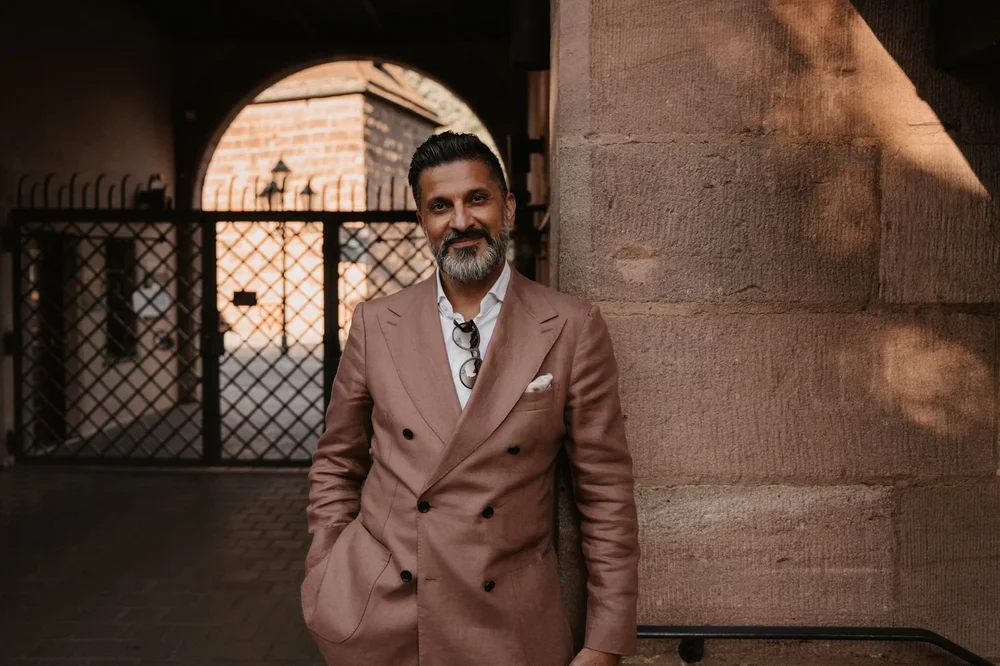
Professor · Researcher · Educator · Founder
THE SIGNATURE IDEA
The six forces model
Porter’s five forces describe the pressures on a firm. The six forces model adds complexity as a sixth force and puts the Viable System Model at the centre: a firm keeps its power position only if its own regulator can absorb the variety the six forces produce. The model joins Porter’s strategy with Ashby’s law of requisite variety and Beer’s Viable System Model, nested in layers from economics to complex strategy.
Kamran (2013, 2019, 2020) · Strategic Value Chain Management, Kogan Page →
SIX FORCES AROUND THE VIABLE SYSTEM MODEL

The full model: the six forces around the Viable System Model, nested in nine layers from economics to complex strategy, held together by Ashby’s law. Kamran (2013, 2019, 2020).
2
doctorates: University of Twente 2021, University of Latvia 2019
5
master’s degrees: MBA-GM, MBA-PPM, EMBL-HSG, LL.M., M.Sc.
10,087
teaching hours across five institutions (as of 2026)
2
vhb online courses developed with Bavarian partners
FURTHER QUALIFICATIONS
KNIME Certified Trainer (2026): data workflows, machine learning and text analysis.
Harvard Law School, Harvard Negotiation Institute (2011, 2012): complex deals and negotiation.
RESEARCH
Four questions I keep returning to
01 · Strategy and resilience
How do firms remain viable when uncertainty and disruption outpace their structures?
02 · AI, marketing and design science
What changes when marketing is designed from within technology, not aimed at people from outside it?
03 · Sustainability and societal value
How can firms create economic value and the common good at the same time?
04 · Dementia and computational meta-science
Where does dementia research spend its effort, and where should it?
AGMI · ARTIFICIAL GENERAL MARKETING INTELLIGENCE
A bridge between marketing and AI
I apply design science, product semantics and AI to the work of marketing teams. From this work I coined the term Artificial General Marketing Intelligence (AGMI): a control system of general intelligence that serves as a bridge between marketing and AI.
AGMI reads the cyber-physical environment, society and the organisation, and turns their demands on marketing into normative, strategic and operational decisions, from meta-level rationality and dynamic capabilities to weak-signal scanning and pattern recognition, learned by a deep neural network.
BRIDGING THE GAP
As complexity grows, AI-driven marketing pulls away from traditional marketing.
Fig. 2 · AGMI is a ubiquitous control system of general intelligence that bridges the fields of marketing and AI and closes the gap.
FROM THE TWENTE PHD · DESIGN-DOMINANT LOGIC
From the unique selling proposition to the unique design proposition
Marketing has moved from taking goods to market, through marketing to segments and co-creating with customers, to a design-dominant logic in which firm and customers co-evolve. My doctoral thesis adds this fourth stage, the market within, to Lusch’s (2007) three, and proposes the Design Weltanschauung as the firm’s normative model for it.
FROM CO-CREATION TO CO-EVOLUTION
In the design-dominant logic, firm and customer no longer only co-create value. They co-evolve meaning.
The firm brings its dynamic capabilities of resource integration; the customer lives in cyber-physical spaces. The Design Weltanschauung sits between them and holds raison d’être, now and future together. Over time, the meaning search space and the design search space unite, and artefacts become innovations and new worlds.
PHILOSOPHY INTO MARKETING
My work integrates and extends Bourdieu’s and Derrida’s dimensions and Heidegger’s phenomenology into marketing.
Bourdieu’s capitals and habitus explain why the old segments no longer hold. Where taste, information and concern converge worldwide, marketing meets the customer in a fifth space, from within.
Selected work, 2026
All publications →FEATURED · BOOK CHAPTER · SPRINGER 2026
Design Thinking Reconsidered: Pragmatist Roots, Phenomenological Turns, and Heidegger’s Zuhandenheit
A rereading of design thinking through its pragmatist roots and its phenomenological turn, with Heidegger’s readiness-to-hand as the key to how designers work with things.
In: Machado, C. F. & Davim, J. P. (eds.), Entrepreneurship and Innovation. Cham: Springer, 2026, pp. 149–182.
Read the chapter →JOURNAL ARTICLE · PHILOSOPHY OF MANAGEMENT
Virtue Ethics and the Common Good in Sustainable Food Systems
With Yating Tian and Patrick Baretto
Read the article →BOOK CHAPTER · SPRINGER
Computational Meta-Science Analysis of Dementia Research
With Patrick Baretto
Explore the chapter →SCIENTIFIC EXHIBIT · ECR 2026
Mapping the future of dementia neuroimaging: machine learning identifies three urgent priorities for multimodal diagnostic integration
84,983 publications, 1980–2024. Of 3,847 AI diagnostic models, only 2.3% were validated prospectively in the clinic.
With Patrick Baretto · Poster C-29017
View the results →Books and dissertations

Kogan Page, 2020

PhD, University of Twente, 2021
Dr.sc., University of Latvia, 2019
LAP Lambert Academic Publishing, 2013
Springer and Wiley-ISTE book chapters
All book chapters →
Artificial Intelligence Technologies in Management and Engineering
Wiley-ISTE, 2026 · 2 chapters
Entrepreneurship and Innovation
Springer, 2026 · 2 chapters

XR and Metaverse
Springer, 2026 · 1 chapter

From Industry 4.0 to Industry 6.0
Wiley-ISTE, 2025 · 3 chapters
Building the Future with Human Resource Management
Springer, 2024 · 2 chapters

Technological Challenges: The Human Side of the Digital Age
Springer, 2022 · 1 chapter
- 2026Design Thinking Reconsidered: Pragmatist Roots, Phenomenological Turns, and Heidegger’s ZuhandenheitKamran · Entrepreneurship and Innovation, Springer, pp. 149–182
- 2026Computational Meta-Science Analysis of Dementia Research: Systematic Resource Misallocation and Strategic Reallocation FrameworksKamran & Baretto · Entrepreneurship and Innovation, Springer, pp. 199–245
- 2026Design for an Approach of Rapprochement Between Marketing Science and the Metaverse in Cyber-Physical RealitiesKamran, Baretto & Becker · XR and Metaverse, Springer, pp. 197–211
- 2026Unveiling Management Research’s Thematic EvolutionKamran · Artificial Intelligence Technologies in Management and Engineering, Wiley-ISTE, pp. 223–268
- 2026Holistic Management Quo Vadis? Designing Management Dispositive and Metamorphic Possibilities in the Age of AIBaretto & Kamran · Artificial Intelligence Technologies in Management and Engineering, Wiley-ISTE, pp. 89–134
- 2025Understanding the Metaverse: A Holistic Approach of a Rapprochement with the Marketing DomainKamran · From Industry 4.0 to Industry 6.0, Wiley-ISTE, pp. 81–138
- 2025Model-Based Management: A Safari of Essential Business ModelsKamran · From Industry 4.0 to Industry 6.0, Wiley-ISTE, pp. 139–192
- 2025Add More Marketing to Marketing Doctoral Programs: Answering Hunt and Yadav’s CallsKamran · From Industry 4.0 to Industry 6.0, Wiley-ISTE, pp. 223–289
- 2024Design of Cognition, Cognition of Design: A Cybernetics and Phenomenological Approach to Enhancing Organizational CognitionKamran · Building the Future with Human Resource Management, Springer, pp. 191–228
- 2024The Design of the Cyberphysical Navigator Model as a Sustainable Framework Enhancing Organisational ResilienceKamran & Becker · Building the Future with Human Resource Management, Springer, pp. 95–125
- 2022Towards a Unified Theory of the New Market Realities in Cyber-Physical Design Search SpacesKamran, Reshani & Topp · Technological Challenges: The Human Side of the Digital Age, Springer, pp. 25–59
FROM RESEARCH TO PRACTICE
Turning dementia research into tools people can use

CEREBRA Laboratories AG, a spin-out of OTH Amberg-Weiden, develops digital tools for the early detection of dementia, combining retinal imaging, voice and cognitive assessment.
The CEREBRA Institute for AI in Neurodegeneration Research carries the research side, with clinical and academic partners.
CEREBRA ARGOS-DX
Every 3 seconds, dementia begins unseen
Most cases are found late, when damage is done. ARGOS-DX aims at triage in primary care, years before symptoms show, without a costly and invasive PET scan.
57M
people live with dementia today, 139M expected by 2050
≈75%
of cases worldwide are undiagnosed
2/3
of older people with dementia are women
€3–4K
per PET scan: invasive, costly and hard to scale
TYPES OF DEMENTIA
OUR SYSTEMATIC LITERATURE ANALYSES
300,021
dementia articles
84,983
neuroimaging articles
54,687
cognitive-games articles
49,842
voice-biomarker articles
11,302
dementia-technology articles
From scientific discovery to AI-powered innovation.
We are never solving the actual problem.
FOUR SIGNALS, ONE DECISION
Retinal biomarkers
Spectral and vascular features of the eye, non-invasive and patient friendly.
Gamified cognition
Short games that measure processing speed, executive function and memory.
Voice biomarkers
Speech, language and linguistic markers from a few minutes of talking.
Explainable AI
Fuses the signals into a risk estimate the clinician can check and act on.
Sources: WHO (2021), Global status report on the public health response to dementia; ADI (2021), World Alzheimer Report; Rommel et al. (2025), Journal of Health Monitoring 10(1). From the CEREBRA talk in Riga, October 2026.
TALKS AND EVENTS
In the lecture hall and on the conference floor
Teaching
Bachelor's, Master's, MBA, DBA and executive education in strategy, cybernetics, marketing and design science.
Courses →Supervision
Master's and doctoral projects. Send your programme, question and timeline.
Propose a topic →Leadership
Programme lead at OTH and ISM, member of the OTH Senate, guest researcher at the University of Twente, and Associate Member of the European Society of Radiology (2026).
About →BEYOND THE LECTURE HALL
Research collaboration, supervision or a talk?
A short note with your question is the best start.